Best for: US households paying for satellite TV who are weighing satellite TV vs streaming and want to know whether streaming or IPTV can replace the dish, and what their internet connection needs before they cancel.
Disclosure: PrimeStream TV 4K sells an IPTV service, so read our ranking of our own option with that in mind. We score every option on the same criteria and say clearly when another choice fits you better. By David, PrimeStream TV 4K.
Comparing your satellite bill with IPTV? Ask us which plan fits your screens, or test it free for 24 hours first. See plans from $14/month →
Published: November 16, 2026 · Last updated: November 16, 2026
Key takeaways
- Satellite needs no home internet; streaming does. That single fact decides most switches. Check your speed and your address on the FCC map before you cancel anything.
- Five HD screens fit inside 100 Mbps. Our math puts five HD screens at about 75 Mbps, while five 4K screens need about 125 Mbps.
- TV service prices keep rising. The federal price index for cable, satellite and live-streaming TV rose 3.3% in the 12 months to September 2026.
- A prepaid plan fixes your cost for the period. Our 12-month plan is a one-time $59 for one device, with no auto-renewal. You can test it free for 24 hours first.
- Keep the dish until the test is done. Switch only after your channels and a live evening game play well on your own TV.
1. Satellite TV vs Streaming: What Is the Difference?
Satellite TV sends live channels from a satellite to a dish on your home, then to a receiver box on each TV. Streaming and IPTV send the same kind of live channels over your internet connection to an app on a Smart TV, a streaming stick, a phone or a computer.
So the real question in streaming vs satellite is not picture quality. It is whether your home internet is strong enough, and whether you want a dish, a box and a long agreement, or an app and a flexible plan.
- Satellite TV: dish plus receiver, no home internet needed for live channels, billed monthly.
- Live TV streaming services: an app, internet required, billed monthly.
- IPTV vs satellite TV: IPTV also uses an app and internet, and our plans are paid once per period (1 to 12 months).
Coming from cable instead? Our IPTV vs cable TV comparison covers that switch.
2. Satellite TV vs Streaming vs IPTV vs Antenna: Comparison Table
Prices and criteria checked November 2026.
| Criteria | Satellite TV | Live TV streaming services | IPTV (our option) | Antenna |
|---|---|---|---|---|
| Price | Monthly bill. Compare the single “all-in” price line, which FCC rules require on bills | Monthly subscription; check each service’s own price page, since prices change often | $14 for 1 month or $59 for 12 months, 1 device (our plans page, Nov 2026) | One-time purchase, no monthly fee |
| Channels | Package and area decide the lineup | Licensed lineups, local channels vary by ZIP code | 55,000+ live channels and 190,000+ movies and series (our site, Nov 2026) | Local over-the-air stations only |
| Devices | Dish plus a receiver per TV | Apps on TVs, sticks and phones | Firestick, Smart TV, Roku, Apple TV, Android, phones, computers | Any TV with a tuner |
| Contract | Can include a term agreement; read yours | Usually month to month | None; one-time payment, no auto-renewal | None |
| Needs internet | No, for live channels | Yes | Yes, about 15 Mbps per HD screen | No |
| Support | Provider phone and technician visits | Online help centers | WhatsApp, 24/7 | None needed |
| Best for | Homes with weak or no broadband | Viewers who want licensed local channels and cloud DVR | Budget-minded homes with good internet and several screens | Local news at zero monthly cost |
In this satellite TV vs streaming table our option is IPTV, so treat that column with care. If your internet is slow or capped, the satellite or antenna column fits you better.
3. Can Your Internet Replace a Satellite Dish? Our Study
In satellite TV vs streaming decisions, most satellite households we hear from ask the same thing first: will my internet handle it? No page in the current top Google results answers this with numbers per screen, so we built the table.
Question: how much download speed does a home need to replace satellite TV with IPTV, and what does each screen cost per month? Method: we multiplied the number of screens watching at the same time by our own setup guidance (about 15 Mbps per HD screen, the top of our 10 to 15 Mbps range, and about 25 Mbps per 4K screen). We compared the totals with the FCC’s 100 Mbps download benchmark for broadband and divided our 12-month multi-device prices by screens and months. Rule: a home “fits” when the total stays at or under 100 Mbps.
Data checked November 16, 2026.
| Screens at once | All HD | All 4K | Within 100 Mbps? | 12-month plan | Cost per screen per month |
|---|---|---|---|---|---|
| 1 | 15 Mbps | 25 Mbps | Yes, both | $59 | $4.92 |
| 2 | 30 Mbps | 50 Mbps | Yes, both | $110 | $4.58 |
| 3 | 45 Mbps | 75 Mbps | Yes, both | $159 | $4.42 |
| 4 | 60 Mbps | 100 Mbps | HD yes; 4K uses all of it | $199 | $4.15 |
| 5 | 75 Mbps | 125 Mbps | HD yes; 4K no | $235 | $3.92 |
The finding: a connection at the FCC’s 100 Mbps benchmark can carry five HD screens at about 75 Mbps, but not five 4K screens, which need about 125 Mbps; per screen, IPTV costs between $3.92 and $4.92 a month on a 12-month plan.
Before you rely on this, look up your address on the FCC National Broadband Map and run a speed test on the TV you will use. For several TVs, our guide to IPTV for multiple devices explains how each screen gets its own connection.
Limits: these are planning figures from our guidance and the FCC’s published minimums, not speed tests. Real use depends on Wi-Fi, other devices online and the stream itself. The table does not prove your connection is stable at peak hours; only a test at home shows that.
Want to see if your connection keeps up? Request the free 24-hour test by form and try it on your main TV tonight.
4. How Much Does Satellite TV Cost a Month?
It depends on the package, your area, equipment and any promotion, so a single national figure would mislead you. The reliable number is on your own bill. Under the FCC’s all-in pricing rule for cable and satellite TV, providers must show the total price for video programming as one clear line on bills and in price ads; large providers had to comply from December 2024. Taxes, equipment and some other charges can still appear separately, so add them.
What we can measure is the trend. The Bureau of Labor Statistics price index for cable, satellite and live-streaming TV service stood at 593.405 in September 2025 and 613.182 in September 2026, a rise of 3.3%. From January 2019 to January 2026 it rose 28.1%.
To settle satellite TV vs streaming on cost, take your all-in line, multiply by 12, and set it next to a prepaid plan. Our IPTV plans cost $59 for 12 months on one device, or $110 to $235 a year for 2 to 5 devices, and the price is fixed for the period you pay.
5. What Are the Disadvantages of Satellite TV?
- Weather. Heavy rain or snow can interrupt the signal to the dish.
- Installation. You need a clear view of the sky and a mounted dish.
- Equipment per TV. Each extra room usually needs its own receiver.
- Agreements. A term agreement can carry an early termination fee; check yours before you cancel.
- Rising bills. The price index above shows TV service costs climbing year after year.
Streaming has its own weakness: it depends on your internet. If streams freeze only on one connection, read our check on whether your internet provider is blocking IPTV.
6. Satellite TV vs Antenna
An antenna picks up local broadcast stations for free after a one-time purchase, with no internet and no bill. It does not carry cable networks, and reception depends on your distance from broadcast towers. Many households pair an antenna for local news with a streaming or IPTV plan for everything else.
7. Alternatives to Satellite TV
If satellite TV vs streaming points you away from the dish, the alternatives to satellite TV fall into four groups:
- IPTV: a large live lineup plus movies and series in one app; works on Firestick, Smart TVs, phones and computers.
- Live TV streaming services: licensed channel bundles billed monthly.
- Free ad-supported channels and on-demand apps: fine for movies and shows, weaker for live sports.
- An antenna: local stations only, no monthly fee.
For sports fans, live games are the hardest part to replace; our IPTV for sports page covers speed and game-day tips. The same groups replace cable too, as our alternatives to cable TV guide shows, and the cable vs streaming vs IPTV comparison puts all three side by side.
8. When Satellite TV Is Still the Better Choice
Satellite TV vs streaming is not a win for streaming in every home. Satellite still fits better when:
- Your home has no broadband, or your speed test is far below what your screens need in the table above.
- Your internet plan has a low data cap; streaming several TVs every day uses a lot of data.
- You want one licensed package on one bill and do not want to manage apps.
Questions about the legal side of IPTV? Read our plain-English guide: is IPTV legal in the USA?
9. How to Switch From Satellite TV to IPTV
Once satellite TV vs streaming is settled for your home, this is how switching works with us, step by step:
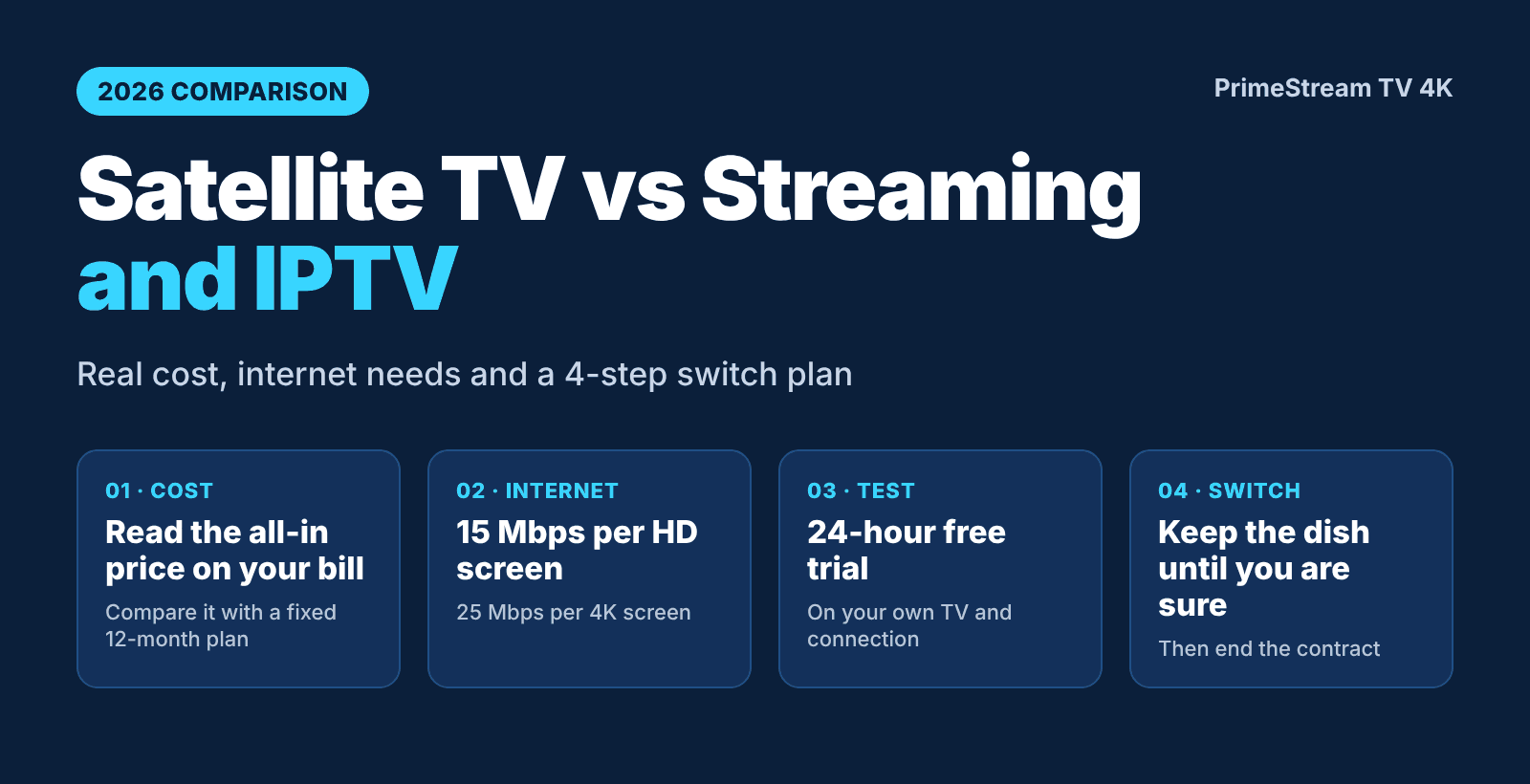
- Check two things first: your internet speed on the TV you will use, and the end date and termination terms in your satellite agreement.
- Request the 24-hour trial: use the form or WhatsApp and tell us your device. No credit card is needed.
- Install the app: we send your login and the recommended app for your device within minutes, and help you set it up.
- Test at peak time: open your must-have channels and a live game in the evening, when traffic is highest.
- Choose a plan: if it plays well, pick a plan; we extend the same login, so your app, favorites and settings stay.
- Then contact your satellite provider: cancel and return any rented equipment as your agreement says. Keep the dish until you are sure.
10. How We Prepared This Guide
- Questions: headings follow Google autocomplete and People Also Ask for “satellite tv vs streaming” and “alternatives to satellite tv”, collected November 16, 2026.
- Price trend: BLS Consumer Price Index series CUUR0000SERA02 (cable, satellite and live-streaming TV service), via FRED, values read November 16, 2026. October 2025 was not published, so we compared September with September.
- Speed guidance: the FCC Broadband Speed Guide (5 to 8 Mbps for HD, 25 Mbps for 4K) and our own setup guidance.
- Billing rule: the FCC’s All-In Pricing for Cable and Satellite Television Service rule in the Federal Register. Check the FCC for any later change.
- Our prices: our plans page, November 16, 2026. Search demand: DataForSEO, Google Ads volumes for the USA, November 2026.
- Testing: we did not run speed tests for this guide, so the study is a planning model, not a measurement.
11. Satellite TV vs Streaming: FAQ
Do you need internet to have satellite TV?
No. Satellite TV receives live channels through the dish, so it works without home internet. Streaming and IPTV need internet: about 15 Mbps per HD screen and about 25 Mbps per 4K screen watching at the same time.
Is streaming cheaper than satellite TV?
Usually, if your internet is already good enough. Multiply the all-in line on your satellite bill by 12 and compare it with a prepaid plan; one IPTV device costs $59 for 12 months with us, or $3.92 to $4.92 per screen per month on 12-month plans.
How much does satellite TV cost a month?
It depends on your package, area and equipment. FCC rules require cable and satellite providers to show an all-in price line for video programming on bills, so use that line. The federal price index for this kind of service rose 3.3% in the 12 months to September 2026.
What are the disadvantages of satellite TV?
Weather can interrupt the signal, you need a mounted dish with a clear view of the sky, each TV usually needs a receiver, and agreements can carry early termination fees. Bills have also kept rising year after year.
Is satellite TV still worth it?
Yes, when your home has no broadband, a slow connection or a low data cap. If your internet comfortably covers your screens, streaming or IPTV usually costs less and needs no dish.
How do I switch from satellite TV to IPTV without losing TV?
Test first. Request a free 24-hour IPTV trial, check your channels and a live evening game on your own TV, choose a plan if it works, and only then cancel satellite and return any rented equipment.
12. Conclusion
Satellite TV vs streaming comes down to your internet. If your connection covers your screens in the table above, streaming or IPTV removes the dish, the boxes and the rising bill; if it does not, satellite remains the safer choice. Test before you cancel: request the free 24-hour trial, then compare our IPTV plans with your all-in satellite line.
Ready to compare your satellite bill? Message us on WhatsApp and we help you choose the right plan for your screens.
Start your free 24h trial
No credit card. We reply with your trial login.