← Back to PrimeStream TV 4K Home
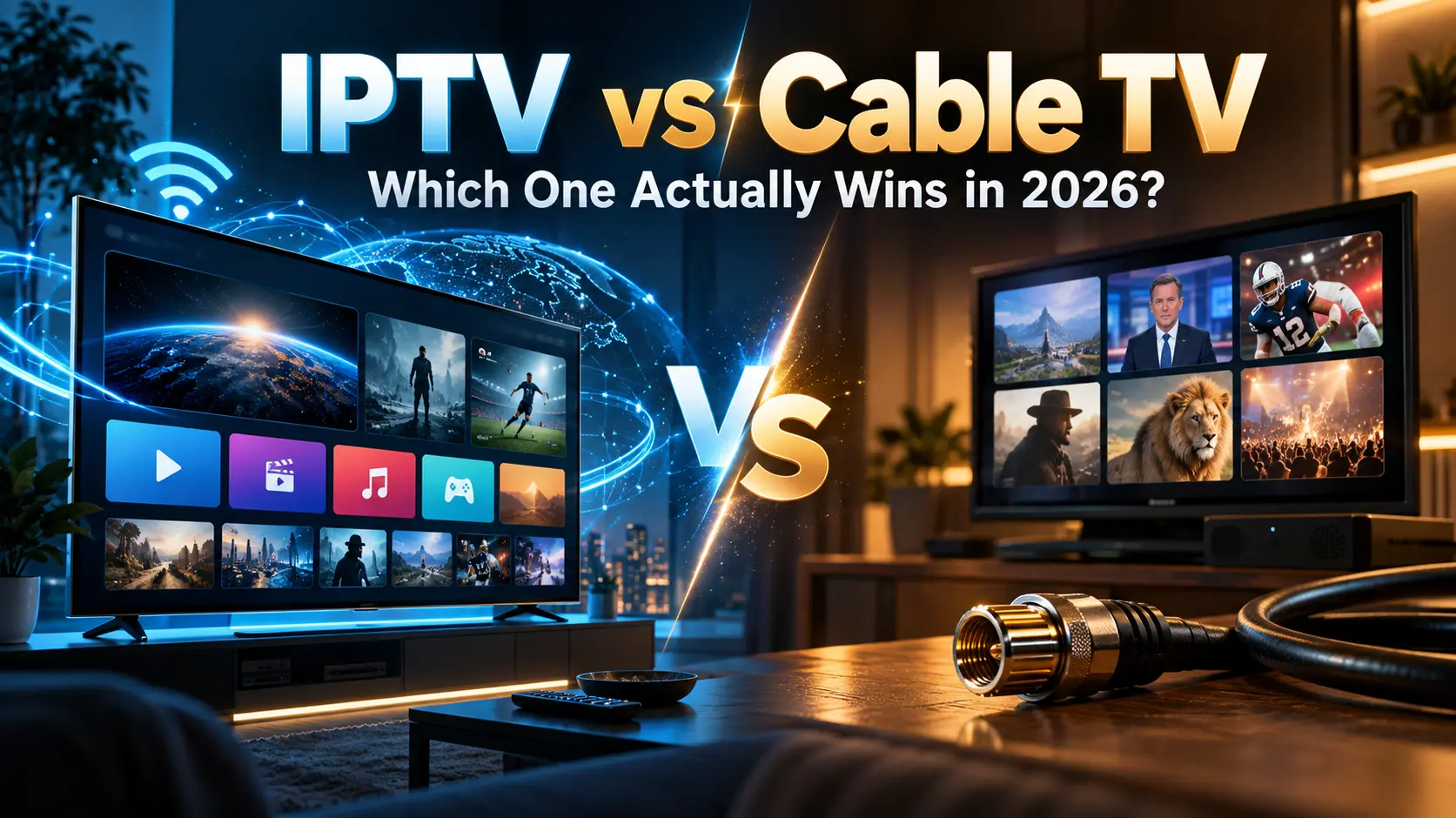
This IPTV vs Cable TV comparison breaks down cost, channels, contracts, and picture quality — so you can decide in five minutes, not fifty.
Quick answer: In this IPTV vs Cable TV comparison, IPTV wins on price, flexibility, and channel count for most households in 2026 — a single IPTV connection typically costs $10–20/month versus $80–170/month for cable, with no equipment rental, no long contract, and access on any device. Cable still wins if your internet connection is unreliable or under 15 Mbps, since IPTV streams over the internet while cable delivers its signal independently of your Wi-Fi.
What is IPTV?
IPTV (Internet Protocol Television) delivers live channels, movies, and series over a standard internet connection instead of through satellite dishes or coaxial cable lines. You watch through an app or player (like TiviMate, IPTV Smarters Pro, or a Smart TV app) on a Firestick, Android box, smart TV, phone, or computer — no dish installation, no technician visit, no dedicated cable line required.
Because it runs over the internet, an IPTV subscription can include tens of thousands of live channels and a full on-demand movie and series library, updated continuously, without the hardware limitations that cap traditional cable packages. That’s the core of the IPTV vs Cable TV divide: internet delivery versus a fixed physical line. For the full breakdown of terms and how it works, see our guide on what IPTV is.
What is cable TV?
Cable TV delivers channels through a dedicated coaxial line run directly to your home by a local provider. It doesn’t depend on your internet connection at all, which is its main technical advantage — but it comes with fixed channel bundles, rented set-top boxes, installation appointments, and contracts that usually lock you in for 12–24 months.
IPTV vs cable TV: side-by-side comparison
| Factor | IPTV | Cable TV |
|---|---|---|
| Monthly cost | $10–20 (single device) | $80–170+ |
| Contract | None — cancel anytime | Usually 12–24 months |
| Equipment | Your existing device + app | Rented set-top box (extra fee) |
| Channel count | Tens of thousands, worldwide | 100–300, regional bundles |
| On-demand library | Large, constantly updated | Limited, extra pay-per-view fees |
| Installation | Instant, self-setup | Scheduled technician visit |
| Depends on internet? | Yes (needs stable connection) | No |
| Device flexibility | Firestick, Android, iOS, Smart TV, PC | Provider’s box only |
Cost breakdown: what you actually pay per year
The IPTV vs Cable TV cost gap is where most households notice the difference fastest. A typical cable package with sports and premium channels runs $100–150/month once fees and equipment rental are added — that’s $1,200–1,800 a year, before any price increase after your promotional period ends. A comparable single-device IPTV subscription covering live TV, sports, and on-demand content runs roughly $120–240 a year, no equipment fees, no rate hikes at renewal. Multi-device households save proportionally more, since one IPTV plan can often cover several screens for a fraction of what a second cable box would cost.
Pros and cons of each
IPTV
Pros: Lower cost, no contract, huge channel and VOD selection, works on any device, instant setup.
Cons: Needs a stable internet connection (5–25 Mbps depending on quality), service quality varies by provider.
Cable TV
Pros: Doesn’t rely on internet speed, consistent signal, long-standing regulation and support infrastructure.
Cons: Expensive, long contracts, rented equipment, limited channel bundles, installation wait times.
Which one should you choose?
This IPTV vs Cable TV decision usually comes down to two things: your internet connection and your budget.
- Choose IPTV if: you have a stable internet connection, want more channels and on-demand content for less money, watch on multiple devices, or don’t want a long-term contract.
- Choose cable if: your internet is unreliable or slow, you live in an area with frequent outages, or you strongly prefer a single dedicated line unaffected by network issues.
- Not sure yet? Most providers, including PrimeStream TV 4K’s free trial, let you test real channel quality on your own setup before paying anything — the fastest way to know for certain.
Ready to try IPTV instead of cable?
Start a 24-hour free trial with 55,000+ live channels and 190,000+ movies and series in HD and 4K, on the device you already own.
Frequently asked questions
Is IPTV cheaper than cable TV?
Yes. A single-device IPTV subscription typically costs $10–20 a month, compared to $80–170+ for a cable package once equipment rental and fees are included — a yearly saving of $1,000 or more for most households.
Do I need fast internet for IPTV?
A stable connection of at least 10–15 Mbps is enough for HD streaming, and around 25 Mbps for smooth 4K playback. Wired Ethernet or 5GHz Wi-Fi gives the most consistent results.
Can I watch IPTV on the same devices as cable?
You can watch IPTV on far more devices than cable allows — Firestick, Android TV, Samsung and LG Smart TVs, iPhone, iPad, Apple TV, Windows, and Mac — using a dedicated player app rather than a rented set-top box.
Is IPTV a contract-free service?
Most IPTV providers, including PrimeStream TV 4K, run month-to-month with no long-term contract, so you can cancel or change plans anytime without an early-termination fee.
Does IPTV include sports and live channels?
Yes. Quality IPTV subscriptions include live sports, news, and entertainment channels alongside on-demand movies and series, often with far more regional and international channel options than a standard cable bundle.
What happens if my internet goes down?
Since IPTV streams over the internet, an outage will interrupt playback, which is the main trade-off compared to cable’s independent signal line. A stable, uncapped home internet connection avoids this in normal conditions.
That wraps up our IPTV vs Cable TV comparison for 2026 — the right choice comes down to your internet reliability and how much flexibility you want from your subscription.